Tribute to François Figueras
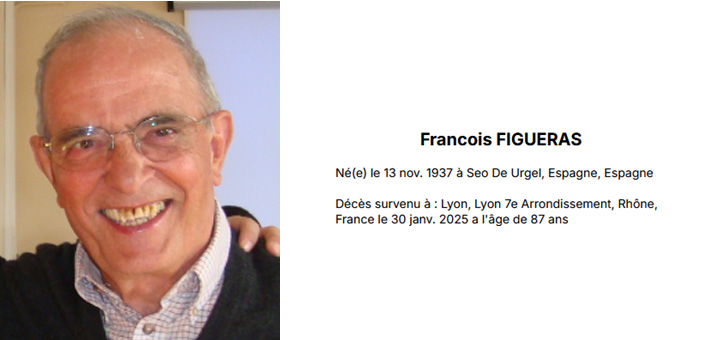
He arrived in France at the age of two with his parents, who were persecuted by the Franco regime. He lived in the Ain region before moving to Lyon in 1953. After studying at the Lycée des Minimes and completing his preparatory classes, he enrolled at ESCIL, graduating in 1961. Immediately afterwards, in 1962, he joined the Institute for Research on Catalysis as a CNRS intern. He began his research in the chromatography department.
In 1966, François Figueras Roca defended his first thesis entitled: Contribution to the study of different types of adsorption using dynamic methods.
And, in 1967, his first article, ‘Adsorption of paraffins on a silica-alumina catalyst, by chromatographic means,’ was published in Bull Soc Chim. This marked the beginning of a prolific career that would result in more than 230 articles, 10 patents, the supervision of more than 40 theses and strong international relations with Mexico (consultant to the Mexican Petroleum Institute), Morocco, India, Bulgaria, Spain… but also close industrial collaborations with Rhône Poulenc, Elf, Roche…
After adsorption, he turned his attention to kinetic studies, notably through acid catalysis (1968), supported metals (1970–1995), oxidation (1967–1980) and, from 1992 onwards, basic catalysis, a field in which he made significant contributions. Lavoisier Medal in 1993. He was a passionate, eclectic researcher. The preparation of catalysts was his motivation. Among other things, he tackled the synthesis of zeolites and then intercalated clays (internationally recognised in this field, his 1988 review is still cited) and his favourite reactions were those of fine chemistry. Head of the oxidation team at the IRC, he left for Montpellier in 1979 to set up a catalysis laboratory (starting from scratch) with a vision of the links between fundamental and applied research that was innovative for the time and with a broad international outlook. In 1993, he organised Europacat-1, the first European catalysis conference, in Montpellier. He then returned to the IRC in 1994 and retired in 2004 (continuing his work as an emeritus professor). François, nicknamed ‘the Catalan’ at the beginning of his career, did not go unnoticed. He always had sharp but well-founded scientific remarks to make, his head buried under his beret. Through his dynamism and passion, François made our scientific field very lively.
Joseph Lopez, his penultimate doctoral student (1999), summed up their relationship as follows: François was a thesis supervisor who gave ideas the opportunity to express themselves and grow in confidence. I also remember his distinctive Catalan accent, which was an integral part of his personality, but also a lesson in scientific communication: never contradict yourself! So only put forward arguments that you are sure are true.
François passed away on 30 January 2025 at the age of 87. On 21 October 2025, during the 19th Mexican Catalysis Congress, a posthumous tribute was paid to F. Figueras, who left his scientific mark on this community during his many visits and thesis supervisions.
The CNRS and our Institute pay tribute to this creative and dynamic spirit.
Tribute from Mexican colleagues: https://www.ircelyon.univ-lyon1.fr/wp-content/uploads/2025/12/HOMENAJE-DR.-FIGUERAS-CMC2025-FINAL.pdf