Welcome to Florent Perret: Meeting Our New Professor
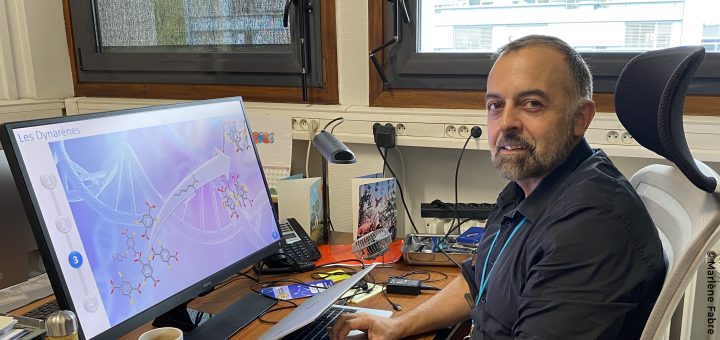
Professor at Ircelyon, Florent Perret brings his expertise in supramolecular chemistry and organic synthesis to the laboratory’s teams. His goal is to bridge macrocycles and MOFs for environmental applications. Career, projects, and discoveries: interview with a chemist seeking to integrate molecular cavities into porous materials.
Could you briefly present your academic and professional background before joining Ircelyon?
I am an organic chemist and specialist in supramolecular chemistry. My PhD in Physical Chemistry focused on the complexation of biological molecules by sulfonated calixarenes (University of Clermont-Ferrand). I continued with a postdoctoral stay at the University of Geneva, in Stefan Matile’s group, where I worked on designing artificial ion channels.
Later, I joined Lyon 1 Claude Bernard University in 2008 as an assistant professor at IUT Lyon 1. I then moved to ICBMS, where I developed research around orgainc synthesis and supramolecular chemistry for biological applications (cyclodextrins, water-soluble calixarenes…).
Over the past ten years, my research has focused on using dynamic combinatorial chemistry to synthesize new macrocyclic molecules, which we named Dyn[n]arenes. These studies led me to explore molecular recognition, self-assembly in water, and the use of molecular cavities to selectively complex guest molecules, with applications particularly in health.
With my European partners, I notably secured European funding for the ERA4HEALTH project NextNano4Cancer 2025-2028. This aims to develop a new formulation based on cyclodextrins, calixarenes, and dynarenes to improve, on one hand, the delivery of anticancer molecules, and on the other, to combat multidrug resistance.
What research projects or themes will you work on at the lab? What do they entail?
My appointment as a full professor and joining Ircelyon mark a new step in my career. The aim is to further integrate organic and supramolecular chemistry with porous material chemistry, particularly focusing on Metal-Organic Frameworks (MOFs). The general idea is to incorporate macrocyclic molecules such as dynarenes, calixarenes, cyclodextrins, or other supramolecular hosts into these materials to provide pores with molecular recognition properties not usually found in conventional materials: these are called MOFs with hierarchical porosity.
The originality of my project lies in using dynamic combinatorial chemistry (DCC) to design cyclic macromolecules tailored to the target molecule to be complexed or separated. The advantage of such macrocycles formed by DCC is that the bond is reversible and can be disassembled via an external stimulus.
The objective is particularly to explore these systems for environmental challenges: gas capture and separation, notably CO2, water and air depollution, micropollutant capture… but these materials could also be used for catalysis.
What collaborations do you wish to develop within Ircelyon and beyond?
At Ircelyon, I first wish to develop collaborations with researchers working on MOFs in the ING team to which I am attached (Jérôme Canivet, David Farrusseng, Michaele Bonneau, Cécile Daniel, etc.). The goal is to combine my expertise in organic synthesis and supramolecular chemistry with the laboratory’s background in the synthesis, characterization, and application of these materials.
Of course, I also wish to develop internal collaborations with other teams and continue those I initiated with the C’DURABLE team (co-supervision of Alexis Giraudon’s thesis with Aude Demessence) for the formation of Metal Organic Chalcogenates for applications in thermoelectricity or photoluminescence.
I also want to strengthen my international collaborations, particularly with teams specializing in MOFs and supramolecular chemistry, leveraging the IRP Smolab developed by the ING team and the ICeMS of Kyoto University.
Throughout my career, I have developed a network of collaborations in Europe and Asia, which I wish to mobilize around these new challenges.
What particularly excites you about this field?
What excites me about supramolecular chemistry is the ability to create complex systems from relatively simple interactions. With a macrocycle, you can generate a cavity capable of recognizing one molecule among others, transporting it, protecting it, or modifying its properties.
Porous materials add another dimension: you transition from a single molecule to a material containing potentially an infinite number of functional cavities. It’s this intersection between molecular chemistry and materials science that particularly interests me today.
Why did you choose Ircelyon to continue your research?
Honestly, it was somewhat coincidental. Following the retirement of my colleague Jean-Marc Chovelon, a professorship opened at the Chemistry Department of Lyon’s IUT, where I had been teaching for 18 years. The teaching profile was “Organic Chemistry,” my specialty, and the host lab was Ircelyon.
While environmental science and catalysis were not domains I had previously worked on, I took it as a challenge: demonstrating that the macrocyclic molecules I developed for biological applications could also have significant potential in porous materials, catalysis, and the environment.
I see my arrival as a true complementarity: bringing a supramolecular chemistry and organic synthesis approach to materials challenges, while leveraging the existing expertise at Ircelyon. Joining this institute represents a new step for me and allows me to put this expertise toward concrete environmental issues.
What personal or scientific challenge would you like to overcome through your work at Ircelyon?
The main scientific challenge I wish to tackle is to bridge two fields often studied separately: organic and supramolecular chemistry and MOF science. We know how to design molecules capable of selectively recognizing certain guests, and we also know how to create extremely porous and structured materials. The challenge is now to combine these two properties in a controlled and reproducible manner.
There is a certain continuity: after many years trying to fit molecules into molecular cavities, I am now trying to fit these molecular cavities… into porous materials!
On a personal level, arriving at Ircelyon is a major challenge: gradually building a new team and developing a scientific identity around this interface between supramolecular chemistry, porous materials, and the environment.
Do you have an anecdote to share or a memorable first impression since joining?
More than an anecdote, I was delighted to reconnect with colleagues from my class—people I met over 30 years ago at the IUT Chemistry program, especially Anne Bonhomme, a longtime friend!
It was also a pleasure to find many students from the chemistry department now doing internships, apprenticeships, or even PhD studies at Ircelyon.
I was also touched by the warm and welcoming atmosphere from all members of the institute.
Outside of work, what are your favorite hobbies or activities?
Outside of work, I primarily enjoy clearing my mind by going on hikes and taking in the beautiful landscapes that the region and France have to offer. For the past seven years, I’ve been walking the GR34 in Brittany, a region which is also close to our director Christophe Geantet’s heart. We had exchanged a lot about the Douarnenez area during our first meeting, which made me even more eager to explore it on foot!
I also love traveling and discovering new cultures. I’ve even set myself a personal challenge: to visit all European countries within two years! Only four remain to go… the countdown has begun!
I also enjoy art in general and practice painting in my free time… even if unfortunately, it’s becoming increasingly rare.
Finally, I try to keep myself in good physical shape by regularly going to the gym on campus.